
Donald Trump • Freedom • Current Events
America's Next Great Wave of Innovation
Free enterprise, President Trump's regulatory agenda, and why I believe this November matters for the next generation of American inventors
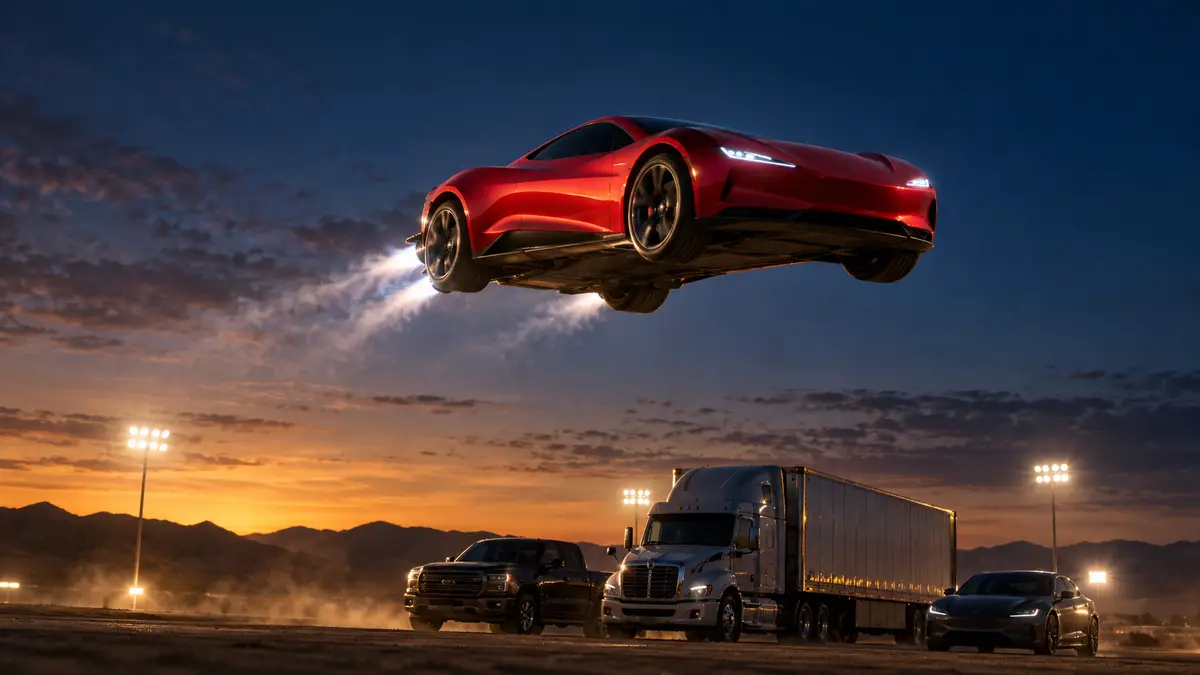
On the night of October 15, 2026, outside Waco, Texas, Elon Musk pulled the cover off the new Tesla Roadster. And then he did something nobody has ever done at a car launch. The car drove up a ramp that curled over until it was upside down, held there by high-powered fans and thrusters, spun around, and set itself back down on the pavement. Then it used SpaceX cold-gas thrusters to lift itself over a whole row of vehicles, a Cybercab, a Cybertruck, a Tesla Semi, a Model Y, and a Model 3, and landed on the other side. Tesla says it will go from zero to sixty in about one second. It looked like something out of a science fiction movie.
It is a prototype, and Musk says production won't start until 2028. But I want you to ask yourself something. What kind of country produces people who would even try that? And what kind of laws make it easier, or harder, for the next generation of inventors to take a crazy idea and turn it into something real?
That question reaches a lot further than sports cars. It applies to energy, manufacturing, medicine, farming, transportation, artificial intelligence, and every other industry that will shape what this country looks like when our grandchildren are grown. In Part One of this series, I walked through twenty-six American inventions and how their blessings spread to millions of people who never knew the inventors' names.
Now I want to talk about the conditions that make the next twenty-six possible, and why I believe those conditions are on the ballot this November.
Ideas Don't Build Factories
Every invention starts with an idea. But an idea cannot build a factory, hire a crew, buy equipment, or put a product on a shelf. An entrepreneur needs investors willing to risk millions on something that might fail. A manufacturer may spend years developing a product, getting permits, lining up suppliers, and building a plant. A small business owner has to borrow money, hire people, buy equipment, and work his way through a stack of federal, state, and local requirements before he ever serves his first customer.
Some of those rules are necessary. Nobody should be free to cheat customers, put workers in real danger, or dump his costs onto the neighbors. But every regulation has a price. It costs time, paperwork, lawyers, and money. A big corporation can hire a whole department to handle it. A small business often can't, and that is where good ideas go to die. A business that never opens never hires anybody. A factory that never gets built never buys a single load of steel. An invention that never reaches the market never blesses anyone.
What President Trump Did About It
President Trump has made cutting federal regulation one of the centerpieces of his economic agenda. On January 31, 2025, he signed Executive Order 14192, Unleashing Prosperity Through Deregulation. It set a policy that whenever a federal agency puts out a new regulation, it has to identify at least ten existing ones to get rid of. In his first term the rule was two for one. This time he made it ten.
The reasoning is simple enough. When you take away compliance costs that don't need to be there, businesses have more money left to invest, research, expand, and hire. A manufacturer buys new equipment. A startup puts more of its capital into the actual product. A builder breaks ground months sooner. A small business owner spends less time filling out forms and more time taking care of customers. How much honest work in this country has been delayed or killed off by requirements that could have been simplified without losing anything that actually protected anybody? I suspect the answer would shock most people.
In my book, The First Horseman, Donald Trump and Biblical Prophecy, I compared the direction of Trump's actions to what the scriptures say about the Antichrist. Here is part of what I wrote. "The Antichrist moves toward total economic control. Trump's consistent pattern has been to reduce government control over economic activity and oppose global elites who openly proclaim that ordinary people should 'own nothing and be happy.'" And again, "Trump has systematically reduced the power of unelected bureaucracies." That is the opposite of the man the scriptures warn us about, and I go through the rest of that comparison in Is Donald Trump the Antichrist?
From the book
The full case is laid out in The First Horseman, Donald Trump and Biblical Prophecy.
Get the Book →Or start with the free chapter,What Seal Are We In? →
Why does this matter so much? Because the Lord told us something about human nature that every voter ought to know by heart…
We have learned by sad experience that it is the nature and disposition of almost all men, as soon as they get a little authority, as they suppose, they will immediately begin to exercise unrighteous dominion. (D&C 121:39)
Almost all men. Not some. Almost all. That revelation was given about priesthood authority, but Joseph Smith was describing human nature, and human nature does not change when a man takes a job in a federal agency. The more power we hand to unelected people over our businesses, our property, and our livelihoods, the more of it will be used the way the Lord said it would be. Every regulation that gets removed for no good reason is a little bit of that dominion handed back to the people.
Alaska and Taiwan
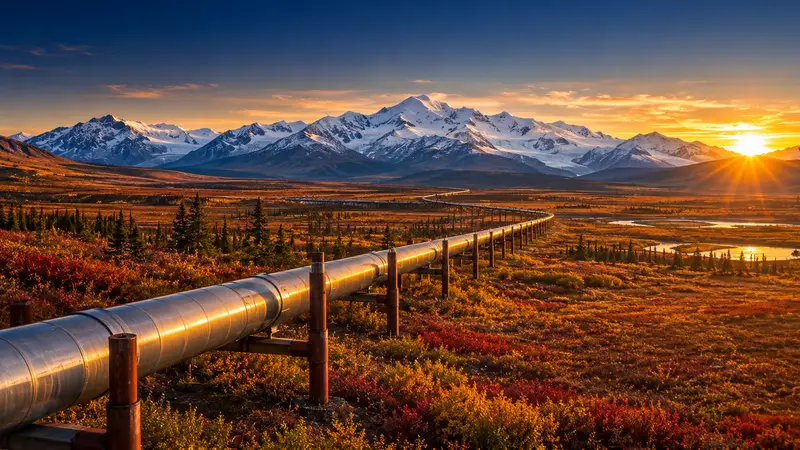
Here is an example from this very week. On October 13, at a rally in Wasilla, Alaska, President Trump announced that Taiwan has agreed to buy thirty percent of the natural gas from the proposed Alaska LNG project for the next twenty years. The project would carry natural gas from Alaska's North Slope through about 800 miles of pipeline to a liquefaction plant on Alaska's southern coast, at an estimated cost of $44.5 billion to $54.5 billion, and export about 20 million metric tons of liquefied natural gas a year. The next day, Taiwan's Ministry of Economic Affairs confirmed that its state-owned CPC Corporation had made significant progress in negotiations and plans to buy 6 million metric tons a year, with an investment of up to $4.4 billion. The President also said all the permits needed to build it have been approved.
I want to be honest here, the same way I would expect anyone to be honest about the other side. The contracts are not final. Taiwan has said the binding details are still being worked out, and the pipeline is not built yet. Final agreements, financing, and construction all still have to come together. But that is exactly what a deal maker does. He gets people to the table who never would have come on their own. In my book I wrote about his "track record of accomplishing what others declared could not be done," and I have written about why I believe Isaiah saw the deal maker coming. Alaska LNG has been talked about for decades without moving. It is moving now.
Why One Big Project Blesses So Many People
Think about who goes to work if this pipeline gets built. Engineers design it. Construction companies need equipment, materials, and skilled labor. Steel mills, trucking companies, machinery suppliers, and specialized contractors get orders. The workers need housing, food, and transportation, and the towns around them feel it. Once it is running, there is export revenue, maintenance work, shipping, and energy production for years. And look at who gets paid. This is an American natural resource, and when Taiwan buys it, money flows back into this country. Alaskans get the biggest share of that blessing, in jobs, in state revenue, and in natural gas for their own homes and businesses. But the whole United States benefits. Families in Taiwan get another reliable source of energy that doesn't have to pass through anyone else's hands, and we get paid for providing it. That is how trade is supposed to work.
New here? I give away Chapter 8 of my book, the one I get asked about more than any other. It makes the scriptural case that the seven seals haven't opened yet, one of the more provocative claims I make. Join the newsletter and it's yours. Get the Free Chapter →
When a company invests billions of dollars in something like this, that money doesn't vanish into a balance sheet. It pays for engineering, equipment, materials, construction, transportation, and labor. The suppliers grow. The employees spend their paychecks at home. The skills and industrial know-how carry over to the next project. Not every dollar spent creates a new dollar of wealth, and a project still has to be worth what it costs. But a good investment sets off a chain of work and opportunity that reaches far past the people who own it. It is the same lesson the twenty-six inventions taught us.
Energy Touches Everything
Factories run on electricity. Farmers need fuel and power for equipment, irrigation, storage, and hauling. Hospitals cannot function without reliable power. The data centers that run modern computing use enormous amounts of electricity. Every business needs heat, cooling, lights, and transportation. When energy gets expensive or unreliable, that cost works its way into everything you buy. When we add reliable energy, every other industry gets a little stronger.
That is why energy policy is about a lot more than energy. It is about the price of groceries and whether the plant down the road stays open.
I want this country to be energy independent. I want us to be self-reliant and self-sufficient as a nation, the same way the prophets have taught every family to be. For decades we shipped our manufacturing, our production, and our supply chains overseas, and during the pandemic we found out how dangerous it is to depend on other countries for the things we need. One of the best things President Trump is doing is bringing that work back home. Every cubic foot of gas we produce ourselves is one we don't have to ask somebody else for.
The Freedom to Try
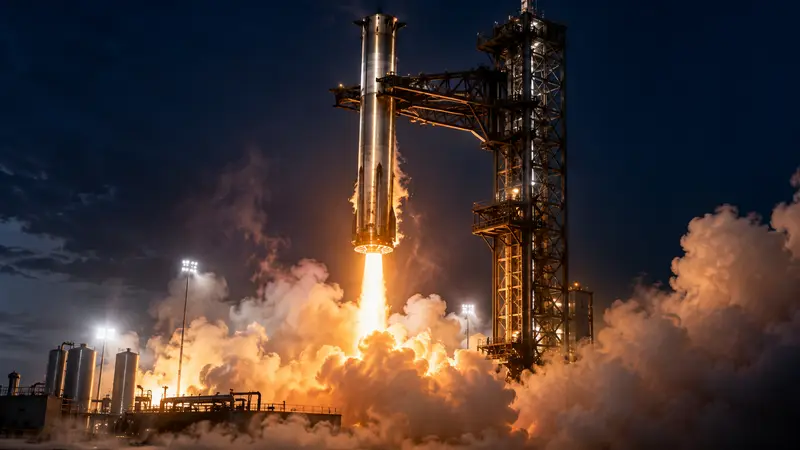
When I watched that Roadster turn upside down and jump a row of trucks, my first thought was that I have been thinking too small my whole life. I have always thought of myself as something of an inventor, even a futurist. I'm nothing like Elon Musk. And it isn't only the cars. His team at SpaceX lands its rockets and flies them again. In October 2024 they caught a returning Super Heavy booster, a rocket taller than a twenty-story building, right out of the air with two mechanical arms on the same tower it launched from. For decades almost every rocket was thrown away after one flight, most of them dropped into the ocean, and every launch had to pay for brand new hardware. Reusing them is saving hundreds of millions of dollars and bringing the cost of getting to space down faster than anybody thought possible.
The Roadster is a very different kind of example. It is not infrastructure. It is an experiment, built by engineers at two American companies who were willing to spend a lot of money attempting something hard. Will flying sports cars ever be a normal thing? I have no idea. But the history of invention is full of experiments that looked silly at the time and turned out to be useful in ways nobody expected. Work on propulsion, lightweight materials, and electronic controls rarely stays inside one product.
What I do know is this. Somebody was free to try. That freedom is where every one of the twenty-six inventions in Part One came from, and it is the thing I most want to protect.
And that is exactly what overregulation takes away. I believe almost every one of us can think of some way to make the world better, in small ways or large ones. But we get so bogged down in getting through the day, the taxes, the paperwork, the permits, the prices that keep going up, that the dream never gets off the kitchen table. Then people look at how hard life has become and decide the answer is to give government even more control. Some of them actually believe communism would fix it. It's the exact wrong answer, and everything in Part One shows why.
Competition or Central Planning
Imagine two companies making the same product. One figures out a way to cut its costs by thirty percent. Now the second company has to improve, find something better to sell, or start losing customers. That pressure is what keeps pushing quality up and prices down. Now imagine instead that a central planning authority decides what gets made, how much, out of what, and at what price. It has to guess what millions of people will want and coordinate thousands of industries at once. As we saw in Part One, the Soviet Union could launch satellites and still not keep bread on the shelves. That wasn't because the planners were stupid. It was because nobody sitting in an office can know what millions of free people know. In a free market, prices and customer choices give constant feedback, and businesses that ignore it lose customers. In a planned economy, that feedback gets replaced by quotas and paperwork.
Is Capitalism Fair?
Capitalism gets criticized because its rewards are unequal. Some people become enormously wealthy and others fail. Some businesses take off and others close their doors. When people start out with different advantages, that can look unfair, and sometimes it is. But unequal rewards by themselves don't tell you whether a system is lifting people up. You have to look at wages, at what a paycheck can buy, at whether people can find work, at whether they can get the goods and services they need, and at whether they can start or grow a business of their own. And a promise of equality doesn't prove a system will deliver prosperity. The twentieth century tested that promise over and over, and it failed every time it was enforced by the state.
They Want You to Own Nothing
I know this is enough for an article of its own someday, but I am going to say it anyway. I don't believe the mess we are in happened by accident. I believe the globalists have done much of this on purpose. In 2016 the World Economic Forum published a video predicting that by 2030, "You'll own nothing. And you'll be happy." Take that line however you want, but I believe it tells us exactly what they want. They want us dependent on them. In my opinion the inflation that has eaten up our paychecks was pushed on us, and the border was left wide open.
Pew Research estimated that 14 million unauthorized immigrants were living in this country by 2023, a record high, and I believe that has driven up the price of housing and held down the wages of working people. At the same time, our manufacturing and production were shipped overseas, which weakens the influence America can have in the world. Put all of that together and you get exactly what Babylon wants. People who are tired, in debt, renting everything, and too worn out to dream.
Measure the Record Honestly
Politicians on both sides throw out big numbers, so let me give you the real ones. As of today, the Bureau of Economic Analysis reports that real gross domestic product grew at an annual rate of 2.5 percent in the first quarter of 2026 and 2.2 percent in the second quarter. The advance estimate for the third quarter comes out October 29, just days before the election. One quarter doesn't tell you everything about a president's policies. You have to look at business investment, jobs, productivity, inflation, energy production, wages, and what a household can actually afford over time. I hold every president to that same standard, regardless of party.
But I will also tell you this. You will not hear much of the good news from the evening broadcasts. In my book I documented that more than ninety percent of major network news coverage of Trump during his presidency was negative. Ninety percent. That is part of why I believe Isaiah described the marred servant the way he did, and it is why I wrote about how much he has accomplished despite the opposition. If you only know the record through the people who hate him, you don't know the record.
Why I Am Voting Republican This November
Let me say this as plainly as I can, because I don't want anyone to misunderstand me. This is my opinion, as one member of The Church of Jesus Christ of Latter-day Saints. The Church is politically neutral. It does not endorse, promote, or oppose any party or candidate, and I would never suggest that it does.
What the Church does do is encourage every member to register, to vote, and to stay involved in civic life with Christlike civility. So I am going to vote, and I am going to tell you why I am voting the way I am.
This is only part of the story. Get the Book →
The Lord gave us a standard for choosing the people who govern us…
Nevertheless, when the wicked rule the people mourn. Wherefore, honest men and wise men should be sought for diligently, and good men and wise men ye should observe to uphold; otherwise whatsoever is less than these cometh of evil. (D&C 98:9–10)
The early Saints also put into the Doctrine and Covenants what they believed government is for…
We believe that no government can exist in peace, except such laws are framed and held inviolate as will secure to each individual the free exercise of conscience, the right and control of property, and the protection of life. (D&C 134:2)
The right and control of property. That is the soil every one of those twenty-six inventions grew in. A man who cannot control the fruit of his own work has no reason to build anything. And I believe the agenda President Trump is pursuing right now, cutting regulations, opening up energy, protecting property, and getting government out of the way of people who want to build something, lines up with that principle better than anything I have seen in my lifetime. But a president cannot do it alone. Congress writes the laws and controls the money. The midterm elections will decide whether Congress helps that agenda move forward or spends the next two years blocking it. That is why I am voting for Republican candidates this November.
King Mosiah understood why this decision belongs to the people…
Now it is not common that the voice of the people desireth anything contrary to that which is right; but it is common for the lesser part of the people to desire that which is not right; therefore this shall ye observe and make it your law—to do your business by the voice of the people. And if the time comes that the voice of the people doth choose iniquity, then is the time that the judgments of God will come upon you; yea, then is the time he will visit you with great destruction even as he has hitherto visited this land. (Mosiah 29:26–27)
The voice of the people only works when the people actually use it. Staying home is a choice too. And when Jesus Christ spoke to the Nephites about our day, He told them exactly why this land was set up the way it was…
For it is wisdom in the Father that they should be established in this land, and be set up as a free people by the power of the Father, that these things might come forth from them unto a remnant of your seed, that the covenant of the Father may be fulfilled which he hath covenanted with his people, O house of Israel; (3 Nephi 21:4)
A free people. That freedom was not an accident, and it was never only about money. It was the ground God prepared so the Book of Mormon could come forth and the gospel could be restored and carried to the world. Every generation has to decide whether to protect it. Ours is no different.
But this is God's country, and freedom here has always come with a condition. Moroni recorded what the Lord told the brother of Jared…
For behold, this is a land which is choice above all other lands; wherefore he that doth possess it shall serve God or shall be swept off; for it is the everlasting decree of God. And it is not until the fulness of iniquity among the children of the land, that they are swept off. (Ether 2:10)
The Book of Mormon gives us two whole civilizations as proof. The Jaredites and the Nephites were both given this land, both prospered on it, and both were swept off when they turned their backs on the God who gave it to them. Swept off like a broom. We are standing at that same place. Either we recognize what we have been given and commit to living God's laws, or this land will be given to someone else.
And yet I am not afraid, and I don't want you to be. What is coming is the establishment of the kingdom of God, and the Lord has promised a place of safety for those who keep their covenants…
And that the gathering together upon the land of Zion, and upon her stakes, may be for a defense, and for a refuge from the storm, and from wrath when it shall be poured out without mixture upon the whole earth. (D&C 115:6)
The righteous who are willing to live by their covenants will be spared, and they will have somewhere to go. Those who refuse and reject all of it will be swept off, just as the Jaredites and the Nephites were.
What Will the Next Twenty-Six Be?
Go back to the list from Part One. The telegraph, the telephone, electric light, the assembly line, the airplane, television, air conditioning, the transistor, the microprocessor, the Internet, GPS. Every one of them changed how people live and work. Now picture what could come in the next fifty years. Medical advances for diseases we still can't cure. Energy that is cheaper and more reliable. Robots doing the dangerous jobs so people don't get hurt. Artificial intelligence helping scientists and engineers solve problems faster. Farming that grows more and wastes less. Ways of getting around that seem impossible today. Nobody can predict all of it. But we know what kind of country they are most likely to come from. They will come from a country where people are free to try hard things, free to keep what they build, and free to fail and try again.
When I look at this, I don't really think about the famous inventors or the billionaires. I think about the farmer who can grow more food. The worker whose tools make a hard job easier. The patient who lives because of a medical breakthrough. The family that can finally afford something that used to belong only to the rich. The small business owner who can compete with a company a hundred times his size because of the technology in his hands. The student who can learn things his grandparents could barely get to. Those are the people who show you what freedom really produces.
So the question is not whether the next great inventor gets rich. The question is whether America keeps the kind of freedom where the next great invention can happen at all, and where its blessings reach millions of people who never imagined it was possible. I believe that question is on the ballot this November, and I hope you will go vote.
In the name of Jesus Christ, amen.
Sources: TechCrunch, October 15, 2026, Tesla Roadster unveiling. The White House, Ten-to-One Deregulation Initiative, January 31, 2025. Voice of America, October 15, 2026, Taiwan's Alaska LNG commitment. Bureau of Economic Analysis, September 30, 2026, GDP Third Estimate. The Church of Jesus Christ of Latter-day Saints, Political Neutrality and Participation. Pew Research Center, unauthorized immigrant estimate.
Research note: AI tools were used extensively in researching the history, facts, and sources for this article. Every scripture quoted here was checked word for word against churchofjesuschrist.org, and the opinions and conclusions are my own.
Keep Reading
Before You Go
Want the full case in one place?
Get the book, or start with my free chapter, What Seal Are We In?, and I'll send a note whenever I publish something new.
Have a thoughtful question? I read every one. Submit a question →