
Freedom • Agency • Free Enterprise
What Happens When People Are Free to Invent?
Twenty-six American inventions, and the blessings that reached far beyond the people who built them
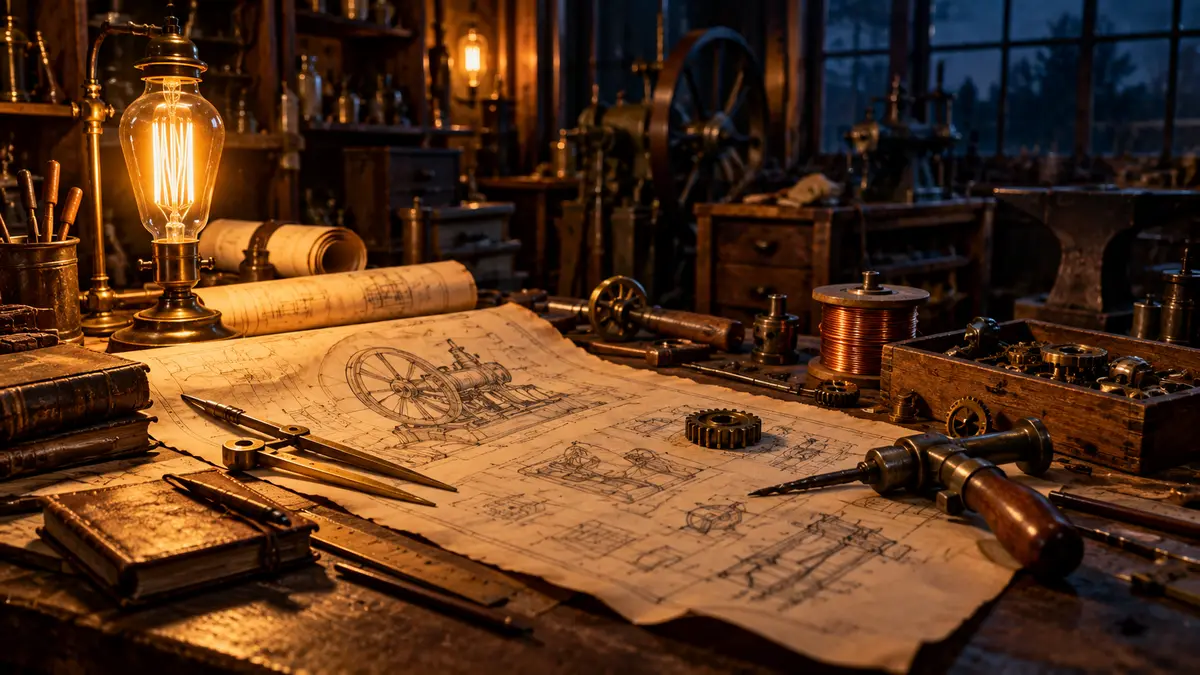
What is the greatest benefit of an invention? Is it the money the inventor makes? The fortune his investors take home? The jobs created by the company that builds it? All of those are real, and I am not going to pretend they don't matter. But I believe the answer is much bigger than any of them, and most of us walk right past it every single day without seeing it.
Picture your home for a minute without electric lights. No refrigerator. No air conditioning, no telephone, no television, no computer, no Internet. Now step outside and picture the street without a single car on it and the sky without an airplane. Every one of those things began with one person who saw a problem, imagined a solution, and then gave years of his life to making it work. Some of them were chasing money. Some were simply curious. Some wanted to do something that had never been done before, and a few wanted to serve their fellow man. Most were a mix of all of it. But whatever drove them, their inventions did something they never could have done by themselves. They blessed millions of people who would never know their names.
That is what this article is about. It is the first of two, and I want to lay the foundation here before we get to where I am really going in the second one. America's history shows us what happens when ordinary people are free to invent, to invest, to build a business, and to compete for the chance to make something useful for somebody else. I think that lesson matters more right now than it has in a long time.
The Inventor Gets Rich. The Rest of Us Get More.
Imagine an inventor builds a machine that does a hard job in one tenth of the time it used to take. He patents it, starts a company, and begins manufacturing. To build that machine he buys steel, electrical parts, tools, packaging, and trucking. He hires engineers, machinists, accountants, salespeople, and maintenance crews. Those employees go home and feed their families and spend their paychecks in their own towns. Then other businesses start making replacement parts and servicing the machines. Competitors study his design and build a better one. Production grows. Prices fall. And a machine that only a big corporation could afford ten years earlier ends up in the hands of a small shop owner, who now serves more customers and maybe hires a few more people himself.
Yes, the inventor got wealthy. But look at everything else that happened.
This isn't wishful thinking. In 2004, Yale economist William Nordhaus published a study called Schumpeterian Profits in the American Economy, which looked at American technological progress from 1948 to 2001. He concluded that the companies producing those advances kept only a tiny fraction of the value they created. Almost all of it went to consumers. To you and me. We notice the inventor's fortune because it makes the news. We never see the hours a family saves every week because of a washing machine, or the patient whose life was saved by a heart monitor built from parts somebody else invented decades earlier, or the small business owner who does with one laptop what used to take a whole office full of people. Those blessings are real. They are just quiet.
That is why I have never resented a man for getting rich off a good invention. Whatever he made, the rest of us came out far ahead.
The Servant Who Buried His Talent
The Savior told a parable that fits this better than anything I could write. A man getting ready to travel called his servants together and handed his goods over to them…
For the kingdom of heaven is as a man travelling into a far country, who called his own servants, and delivered unto them his goods. And unto one he gave five talents, to another two, and to another one; to every man according to his several ability; and straightway took his journey. (Matthew 25:14–15)
The servant with five talents went and traded with them and came back with ten. The servant with two came back with four. And the servant with one went out and dug a hole and buried it. When the lord of those servants returned, here is what he said to the first one…
From the book
The full case is laid out in The First Horseman, Donald Trump and Biblical Prophecy.
Get the Book →Or start with the free chapter,What Seal Are We In? →
His lord said unto him, Well done, thou good and faithful servant: thou hast been faithful over a few things, I will make thee ruler over many things: enter thou into the joy of thy lord. (Matthew 25:21)
The third servant had an excuse. "I was afraid, and went and hid thy talent in the earth" (Matthew 25:25). He lost even the one he had. Now, I am not saying the Savior was teaching a class on economics. He was teaching stewardship, and the talents in that parable are every gift God places in our hands. But the principle runs in both directions. God expects us to take what He gave us and multiply it, and He did not reward the man who buried his gift out of fear. Every inventor on the list below took a gift of mind and imagination and traded with it, and the whole world got the increase.
The Lord said something in the Doctrine and Covenants that I think about every time somebody tells me government should be making all of these decisions for us…
For behold, it is not meet that I should command in all things; for he that is compelled in all things, the same is a slothful and not a wise servant; wherefore he receiveth no reward. Verily I say, men should be anxiously engaged in a good cause, and do many things of their own free will, and bring to pass much righteousness; For the power is in them, wherein they are agents unto themselves. And inasmuch as men do good they shall in nowise lose their reward. (D&C 58:26–28)
If God Himself will not command in all things, why would we want a government that tries to? A servant who is compelled in all things becomes slothful. A people who are compelled in all things become slothful too. The power is in them. That is how God made us, and the history that follows is what it looks like when people are left free to use that power.
Twenty-Six American Inventions That Changed the World
America did not invent everything. Many discoveries came out of Europe and Asia, and most great inventions were improved by people in several countries before they became what we know today. But look at what came out of this one young nation in its first two hundred years. Here are twenty-six, starting not long after the Constitution was signed.
The Early Republic
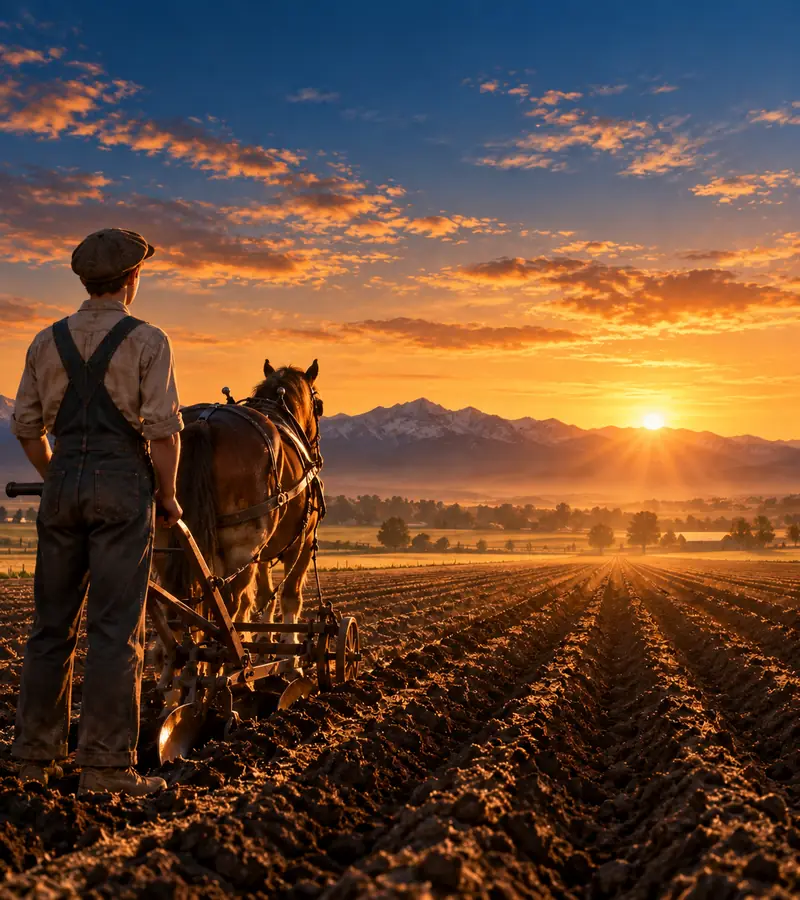
1. The cotton gin. Eli Whitney, 1793. Pulling seeds out of cotton fiber by hand was slow, exhausting work, and Whitney's machine did it many times faster. It transformed the American cotton and textile industries almost overnight. 2. The mechanical reaper. Cyrus McCormick, 1831. Harvesting grain had always meant backbreaking hand labor. The reaper let one farmer harvest far more ground, and as farm machinery kept improving, fewer people were needed to grow the same amount of food. That freed millions of people to do other work, and it built entire industries that make and repair farm equipment.
3. The practical electric telegraph. Samuel Morse, Alfred Vail, and others, 1830s and 1840s. Before the telegraph, news traveled as fast as a horse, a ship, or a train. Suddenly a message could cross the country in minutes. Businesses got market prices the same day, newspapers reported events from a thousand miles away, and railroads could coordinate their trains. 4. The practical sewing machine. Elias Howe and other American innovators, 1840s. It changed how clothing was made, opened new businesses in manufacturing and retail, and eventually brought labor-saving machinery right into the home. 5. The safety elevator. Elisha Otis, 1850s. Otis built a brake that kept an elevator from falling if the cable snapped. Without it, nobody rides an elevator, and without elevators the modern city simply does not exist.
The Age of Electricity
6. The telephone. Alexander Graham Bell, 1876. Distance stopped meaning what it used to mean. 7. The phonograph. Thomas Edison, 1877. For the first time in history, sound could be recorded and played back, and out of that came the entire recording industry. 8. Practical electric lighting systems. Edison and his teams, 1879 and after. Edison did not invent the first electric light, but his work made electric lighting practical and affordable, and the power networks built to run it became the foundation for nearly every invention that followed. 9. The AC induction motor. Nikola Tesla, 1880s. Tesla's American patents helped put alternating-current motors into factories, appliances, and transportation, and electric motors ended up in almost every corner of the economy.
10. Commercial motion pictures. American laboratories and businesses, 1890s. Cameras, viewers, and film systems gave birth to an industry that would employ performers, writers, musicians, technicians, and theater workers by the hundreds of thousands. 11. Modern air conditioning. Willis Carrier, 1902. Carrier built it to control heat and humidity in a printing plant. Today it runs in homes, hospitals, and offices, and it made whole regions of this country livable year round. 12. The powered airplane. Wilbur and Orville Wright, 1903. Two bicycle makers from Ohio achieved sustained, controlled, powered flight. Everything from overnight shipping to emergency air ambulances traces back to a few seconds above the sand at Kitty Hawk.
New here? I give away Chapter 8 of my book, the one I get asked about more than any other. It makes the scriptural case that the seven seals haven't opened yet, one of the more provocative claims I make. Join the newsletter and it's yours. Get the Free Chapter →
Mass Production and the Modern World
13. The moving assembly line. Henry Ford and his teams, 1913. Ford did not invent the automobile, and he did not invent the idea of an assembly line. But his moving line cut the cost of building a car so dramatically that ordinary families could finally own one. Think of everything that grew up around that: tire makers, glass and steel suppliers, dealerships, repair shops, gas stations, trucking companies, and motels. 14. The electric traffic signal. James Hoge and others, 1910s. As cars filled the streets, American engineers came up with electric signals to keep busy intersections from turning into chaos. 15. The liquid-fueled rocket. Robert Goddard, 1926. People laughed at him. His rocket flew anyway, and every satellite, weather report, and space mission since then rests on what he proved in a cabbage field in Massachusetts.
16. Quick freezing. Clarence Birdseye, 1920s. Birdseye learned to freeze food fast enough to keep its quality, and families gained access to a variety of food all year long. 17. Electronic television. Philo T. Farnsworth, 1927. This one is close to home for a lot of my readers. Farnsworth was a Latter-day Saint farm boy from Utah and Idaho who got the idea as a teenager, and in 1927 he transmitted the first electronic television image. Out of that came broadcasting, news, sports coverage, educational programming, and eventually the digital video that reaches billions of people today. 18. FM radio. Edwin Armstrong, 1930s. Clearer sound with far less interference. 19. The first controlled nuclear reactor. Enrico Fermi and his team at the University of Chicago, 1942. That first self-sustaining chain reaction opened the door to nuclear power generation and a great deal of scientific research. 20. The microwave oven. Percy Spencer at Raytheon, 1940s. Spencer noticed that microwave energy could heat food, and that discovery ended up in nearly every kitchen in America.
The Electronic Age
21. The transistor. John Bardeen, Walter Brattain, and William Shockley at Bell Laboratories, 1947. This tiny component replaced bulky vacuum tubes and became the foundation of modern electronics. 22. The integrated circuit. Jack Kilby and Robert Noyce, 1958 and 1959. It put many components onto one small chip, and computers began shrinking and getting cheaper. 23. The laser. Theodore Maiman, 1960. Lasers now show up in surgery, manufacturing, communications, and the grocery store checkout line. 24. The foundations of the Internet. ARPANET and American research institutions, 1969 and after. The World Wide Web was later invented at CERN in Europe, but the networking underneath it was built here. 25. The microprocessor. Intel and its collaborators, 1971. A programmable computer on a single chip, and the beginning of the personal computer. 26. The Global Positioning System. The U.S. government and industry, 1970s and after. GPS started as a defense program. Once its signals opened up for civilian use, it went into farming, trucking, emergency services, and the phone in your pocket.
My list stops in the 1970s, and I did that on purpose. Since then the U.S. Patent Office has issued millions more patents. The Apple Macintosh came out in 1984 and put a computer anybody could use on the kitchen table. The iPhone came out in 2007, and now most of us carry more computing power in our pockets than the engineers who sent men to the moon. Reusable rockets, which I will get to in Part Two, are bringing down the cost of space faster than anyone thought possible. Those are the inventions people know best, because we use them every day.
But the point of this list was never to count gadgets. The point is where they came from. Every one of them came out of a country where a person was free to dream up something better, build it, and keep the reward. Now go looking for the list of great consumer inventions that came out of the Soviet Union in those same years. It is a short one.
One Invention Becomes a Thousand Opportunities
These inventions gave us a lot more than useful objects. They gave us industries. The transistor made the integrated circuit possible. The integrated circuit made the microprocessor possible. The microprocessor made the personal computer possible, and on and on it goes. Each invention became the ground the next one stood on. The airplane needed engines, navigation systems, airports, mechanics, and flight schools. Television needed cameras, studios, broadcasters, and programming. And as all of it spread, people who had never heard of the original inventors gained abilities their grandparents could not have imagined.
The wealth from a great invention does not stay locked up with the inventor. It spreads through jobs, through suppliers, through competition, through lower prices, and through new businesses nobody saw coming. That is the part most people miss.
Why the Reward Matters, and Where It Goes Wrong
Invention takes more than brains. It takes years of work, a lot of money, failure after failure, and a willingness to live with not knowing whether any of it will pay off. Most inventions never make a dime. So why would anyone spend years on an idea that might fail? Sometimes it is a desire to help. Sometimes it is curiosity or ambition. But very often the chance of earning a real return is a big part of the decision, and I don't think there is anything wrong with that. Profit is the reward for solving a problem other people care about enough to pay you to solve it. And when businesses compete, they have every reason to improve quality, cut costs, and build something better than the other guy.
Now, I know where some readers are going with this. Haven't I written about the economic system the scriptures call Babylon? Yes, I have. So let me be clear about the difference. Jacob did not condemn the Nephites for having riches. He condemned them for being lifted up in pride and persecuting their brethren because of those riches. Then he told them exactly how to seek wealth the right way…
This is only part of the story. Get the Book →
Think of your brethren like unto yourselves, and be familiar with all and free with your substance, that they may be rich like unto you. But before ye seek for riches, seek ye for the kingdom of God. And after ye have obtained a hope in Christ ye shall obtain riches, if ye seek them; and ye will seek them for the intent to do good—to clothe the naked, and to feed the hungry, and to liberate the captive, and administer relief to the sick and the afflicted. (Jacob 2:17–19)
That is the line. A man who builds a better machine and gets rich doing it is not Babylon. Babylon is the love of money. It is debt used as a chain, monopolies that crush competitors, fraud, and the kind of secret combinations that rig the whole game for power and gain. Those are real flaws, and a free economy has them because free people have them. But the flaw is in the human heart, not in freedom itself. Take away freedom and you do not remove greed. You just hand it to fewer people with more power.
That is why I believe free enterprise, with all of its flaws, has done more good for more people than any other system men have tried. Nobody has to get permission from a central authority before trying out a good idea. Thousands of people get to try thousands of ideas, and the good ones win.
The Soviet Contradiction

In 1957 the Soviet Union launched Sputnik, the first artificial satellite. In 1961 Yuri Gagarin became the first man in space. Those were real accomplishments by brilliant scientists and engineers. And yet the same country could not keep its store shelves stocked. Economic historians Byung-Yeon Kim and Yoshisada Shida documented how consumer shortages and the black market fed each other across the Soviet republics from 1965 to 1989. Other researchers have shown how central planning gets more and more paralyzed as an economy grows more complicated. How does a country put a man in space and still make its people stand in line for bread and shoes?
A planning committee can pour enormous resources into one national goal it picks out. What it cannot do is keep track of what millions of different people want, from one day to the next, across thousands of industries. In a free market, nobody has to. Prices and customer choices tell businesses what is working, and the ones that don't listen go out of business.
If you want to see it with your own eyes, look at Cuba. Before 1959, the streets of Havana were full of new American cars. Then Fidel Castro's government took over, and the clock stopped. Part of that was the American trade embargo, I'll grant that. But for more than fifty years the Cuban government itself would not let ordinary people freely buy and sell any car that came after the revolution. Until 2011, the only cars Cubans could legally trade among themselves were the ones built before 1959. So that is what they still drive. Sixty and seventy year old Chevys and Fords, held together with homemade parts and a lot of ingenuity. The people never stopped being clever. They just weren't allowed to build anything new.

The Soviet record shows that a nation can be technologically impressive and still leave its people poor. President Ezra Taft Benson spent decades warning us about communism, and history proved him right. And for those who tell me the law of consecration is just socialism with a church name on it, I have written about why the law of consecration is nothing like communism. Consecration is entered freely, by covenant. The Soviet system was enforced at gunpoint. That difference is the whole thing.
The Founders Made Room for Inventors
The Constitution has a clause most people have never read. Article I, Section 8 gives Congress the power to promote the progress of science and useful arts by securing to authors and inventors the exclusive right to their writings and discoveries for a limited time. The Founders understood that if a man could keep the benefit of what he created, he would be more willing to create it, and more willing to share how he did it. Patents are not the only reason America innovated. Universities, laboratories, and public research all played a part. But the principle is right there in the founding document. A society that lets people benefit from what they build gets more people building.
And we know where that Constitution came from…
That every man may act in doctrine and principle pertaining to futurity, according to the moral agency which I have given unto him, that every man may be accountable for his own sins in the day of judgment. Therefore, it is not right that any man should be in bondage one to another. And for this purpose have I established the Constitution of this land, by the hands of wise men whom I raised up unto this very purpose, and redeemed the land by the shedding of blood. (D&C 101:78–80)
The Lord established the Constitution so that every man could act according to his own moral agency. It was never meant to be a government that commands in all things. It was meant to protect people while they use the power God put in them.
What Does Fairness Really Mean?
Most arguments about capitalism come down to inequality. Some people make enormous fortunes and others struggle to pay rent. I am not going to wave that away. It is real, and the Lord expects us to care about it. But there is another question about fairness that hardly anyone asks. Does the system give people a chance to develop their talents? Can a man with an idea start a business? Can a worker improve his situation? Can an ordinary family get the things that make life safer, healthier, and more productive? Does the system reward people for solving problems that bless other people? An economy should be judged by how wealth gets created and not only by how it gets divided.
None of those twenty-six inventions made every American rich. But every one of them changed what was possible for ordinary people. They saved time, opened up information, gave us mobility, and created whole new ways of working and living. And the blessings did not stop at our borders. They went to the whole world.
A Legacy Worth Protecting
For nearly two hundred and fifty years, American inventors and entrepreneurs have helped change the world. It did not come from one man, one party, or one generation. It came from a country where individual initiative, scientific discovery, private investment, good laws, and the freedom to bring a product to market all worked together. But none of that is automatic. It depends on choices about property rights, taxes, competition, regulation, education, and economic freedom, and those choices get made by people we elect. The inventions of yesterday show us what happens when talented people are free to chase hard ideas. The question in front of us now is whether America will keep giving them that freedom.
And we can never forget whose land this is. Lehi saw it centuries before any of us got here…
Wherefore, I, Lehi, prophesy according to the workings of the Spirit which is in me, that there shall none come into this land save they shall be brought by the hand of the Lord. (2 Nephi 1:6)
The people who built this country were brought here for a reason. And the Lord told the brother of Jared exactly what the condition was for keeping this land free…
Behold, this is a choice land, and whatsoever nation shall possess it shall be free from bondage, and from captivity, and from all other nations under heaven, if they will but serve the God of the land, who is Jesus Christ, who hath been manifested by the things which we have written. (Ether 2:12)
Free from bondage. Free from captivity. If they will serve the God of the land, who is Jesus Christ. The freedom that produced every one of those twenty-six inventions was never about money alone. It is a covenant blessing, and covenant blessings come with conditions. In the next article I am going to talk about what is happening right now, this very month, and why I believe the choices we make this November will decide a lot of that.
In the name of Jesus Christ, amen.
Continued in Part Two: America's Next Great Wave of Innovation.
Sources: William D. Nordhaus, Schumpeterian Profits in the American Economy, National Bureau of Economic Research, 2004. Byung-Yeon Kim and Yoshisada Shida, Shortages and the Informal Economy in the Soviet Republics, Economic History Review. Abhijit Banerjee and Michael Spagat, Productivity Paralysis and the Complexity Problem, Journal of Comparative Economics. National Archives, The Constitution of the United States. Historical references: Smithsonian National Museum of American History, U.S. Patent and Trademark Office, Computer History Museum. Cuban car restrictions: The Daily Economy.
Research note: AI tools were used extensively in researching the history, facts, and sources for this article. Every scripture quoted here was checked word for word against churchofjesuschrist.org, and the opinions and conclusions are my own.
Keep Reading
Before You Go
Want the full case in one place?
Get the book, or start with my free chapter, What Seal Are We In?, and I'll send a note whenever I publish something new.
Have a thoughtful question? I read every one. Submit a question →