
Last Days • Babylon • Self-Reliance
The Data Centers Are Not About AI
What They Are Not Telling You About the Buildout Across the West
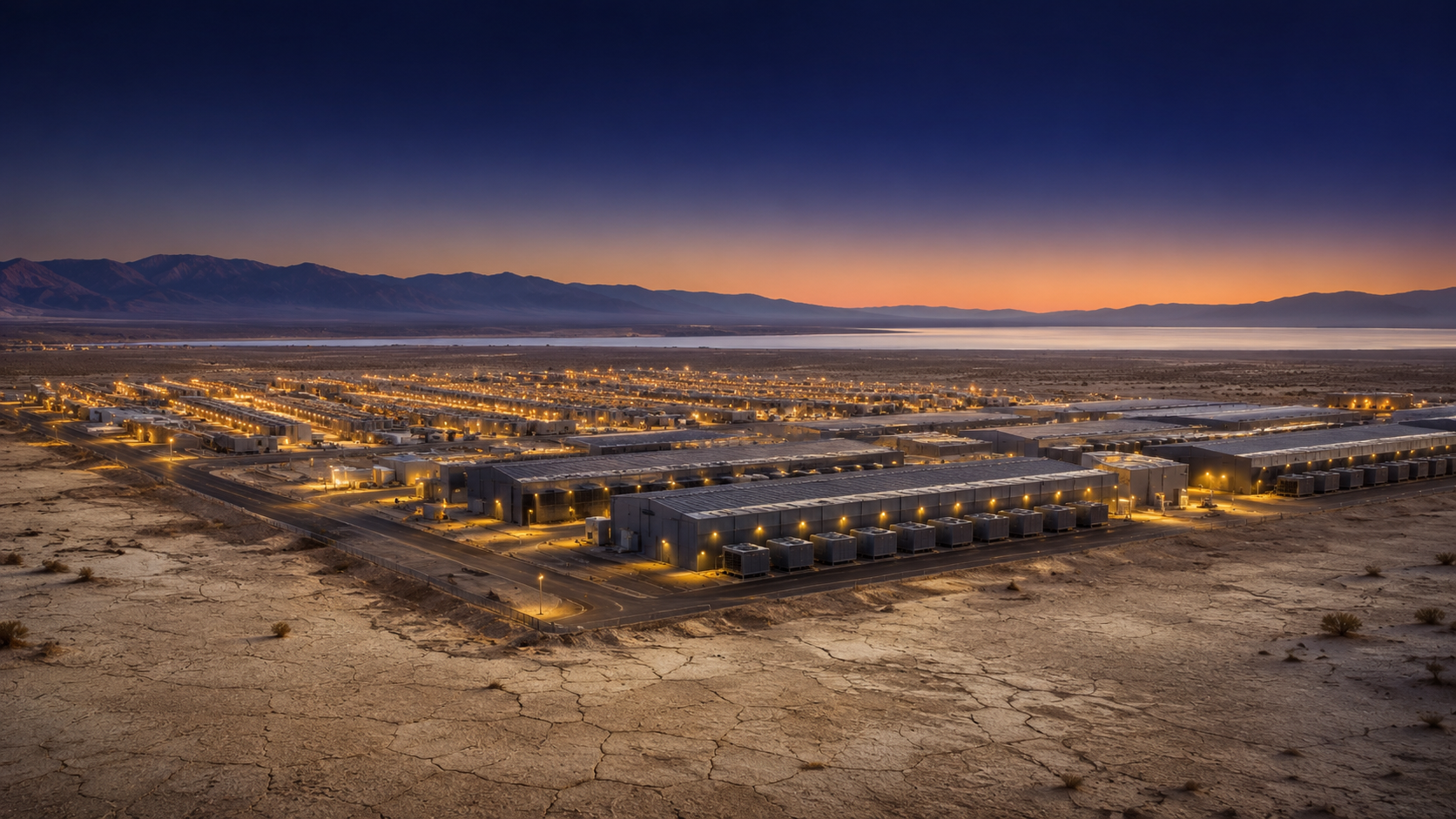
They are coming to the desert. Across Nevada, Utah, Arizona, and out onto the federal land all over this country, the data centers are being planned, promoted, and rushed into existence. The pitch never changes. We need them. The demand for artificial intelligence is enormous, and these facilities are how we meet it. They will bring money. They will bring jobs. They will be the business opportunity of a generation. Investors like Kevin O'Leary have put their weight behind projects so large they are hard to picture. One proposal in Box Elder County, Utah, covered forty thousand acres. Here is a clear-eyed look at what is really being built.
The numbers attached to these projects are hard to absorb, and they point in every direction at once. How much power they will draw. How much water they will drink. How much money a few people will make. The reports vary so widely that it is difficult to know which to trust. But the direction is not in question. These facilities consume power and water on a scale our deserts cannot sustain, and they want to build them in the driest places on the map.
Look at the Great Salt Lake. It has been shrinking for years, and the water that should be feeding it is already promised many times over. Now we are told to welcome facilities that will pull enormous amounts of water and power out of the very region least able to give it. The math does not work, and the people studying it honestly know the math does not work. That alone should make us stop and ask why the rush.
Here is why. The data centers are not really about artificial intelligence at all. AI is the story we are being told. It is the friendly face painted on the building. What these facilities actually do is gather, store, and process information. Yours. Mine. Everyone's. Every search, every purchase, every message, every movement, every face. The product is not intelligence. The product is data, and the data is us.
From the book
The full case is laid out in The First Horseman, Donald Trump and Biblical Prophecy.
Get the Book →Or start with the free chapter,What Seal Are We In? →
Once that infrastructure exists, it does not sit idle. It becomes the backbone of a system that can watch, sort, score, and eventually control. We have already seen what that looks like in parts of the world where a person's ability to travel, to bank, and to buy depends on a compliance score. None of that is possible without the buildings now going up across our deserts. The capacity has to exist before it can be used. They are building the capacity.
Scripture described this kind of system long before the technology existed to build it. John saw it on the island of Patmos and wrote it down.
New here? I give away Chapter 8 of my book, the one I get asked about more than any other. It makes the scriptural case that the seven seals haven't opened yet, one of the more provocative claims I make. Join the newsletter and it's yours. Get the Free Chapter →
And he causeth all, both small and great, rich and poor, free and bond, to receive a mark in their right hand, or in their foreheads: And that no man might buy or sell, save he that had the mark, or the name of the beast, or the number of his name. (Revelation 13:16–17)
For most of history this was impossible to imagine. How could anyone control all buying and selling for every person on earth? You would need to identify every individual, track every transaction, and connect it all across the whole world in real time. That is exactly what this infrastructure makes possible. The mark of the beast is not built in a day. The machinery that could one day enforce it is built quietly, piece by piece, sold to us as convenience and progress.
There is a parallel from our own history that I keep coming back to. In 1981 the United States was pressing forward with the MX missile system, nuclear weapons designed to reach any nation on earth and destroy whatever they were aimed at. The planners needed somewhere to put them, and the deserts of Utah and Nevada looked ideal. The land was vast. It was thinly settled. Much of it was federal ground already under government control.
The Church did not stay silent. On May 5, 1981, the First Presidency, President Spencer W. Kimball, President N. Eldon Tanner, and President Marion G. Romney, issued a statement opposing the plan. They wrote:
This is only part of the story. Get the Book →
Our fathers came to this Western area to establish a base from which to carry the gospel of peace to the peoples of the earth. It is ironic, and a denial of the very essence of that gospel, that in this same general area there should be constructed a mammoth weapons system potentially capable of destroying much of civilization. (First Presidency, May 5, 1981)
The pioneers came to these valleys to build a refuge and to carry the gospel of peace into all the world. To turn that same ground into a launching pad for weapons capable of destroying civilization was a betrayal of the very reason the Saints came here. The statement carried real weight, and the plan was eventually abandoned.
Now look at the same deserts today. The same land. The same federal ground. The same promise of money and progress. The project is no longer a missile field. It is a network of data centers. And this is the part that should give us pause. In some ways these data centers are more dangerous than the MX system ever was. A missile can destroy a city. These systems are built to reach into the mind, the daily life, and the future of every person on the planet. They are designed to gather, to watch, and in time to control. A weapon takes life. This machinery is aimed at agency itself, at the freedom God gave every soul to choose. That is a deeper kind of harm, and it is being sold to us as the opportunity of a lifetime.
Let me be clear about one thing. I am not telling the leaders of the Church what they should do. That is not my place, and I would not presume it. They will act as the Lord directs them, in their own time. What I am saying is different. We, as a people, can be the ones who stand in opposition to this. We do not have to wait to be told. We can see what is being built, and we can decline to hand over our consent.
And I heard another voice from heaven, saying, Come out of her, my people, that ye be not partakers of her sins, and that ye receive not of her plagues. (Revelation 18:4)
Coming out of Babylon is not a retreat into fear. It is a step toward independence. The more self-reliant you and your family become, the less any system can dictate to you.
That is also why I would encourage you to take these data center projects seriously where you live. Show up at the meetings. Ask the hard questions. Oppose the ones that do not serve your community. In many cases you are being asked to fund, with your own resources, a project that benefits a few people while deepening everyone else's dependence. We can see that clearly, and push back on it, without any panic at all.
I write all of this with hope, not dread. There is a way through what is coming, and it is the reason for my book. I am convinced that God has prepared a chosen servant to lead the Political Kingdom of God, a place of real safety built on righteousness and on the willingness to live the law of consecration. Some have decided that Donald Trump is the antichrist. I understand why that idea spreads, but I am persuaded it misreads the scriptures. In my book I make the case that he is the first horseman, God's chosen servant, and that his work is only beginning.
The seven seals have not yet opened. We are living in the time just before they do. That is not a reason to be afraid. It is a reason to prepare, calmly and deliberately, while there is still time to do it well.
My book is here to help you do exactly that, scripture by scripture. You can start reading it today, right here on this site, in both ebook and audiobook form, with more languages on the way. If any of this resonates with you, take the next step.
Before You Go
Want the full case in one place?
Get the book, or start with my free chapter, What Seal Are We In?, and I'll send a note whenever I publish something new.
Have a thoughtful question? I read every one. Submit a question →